

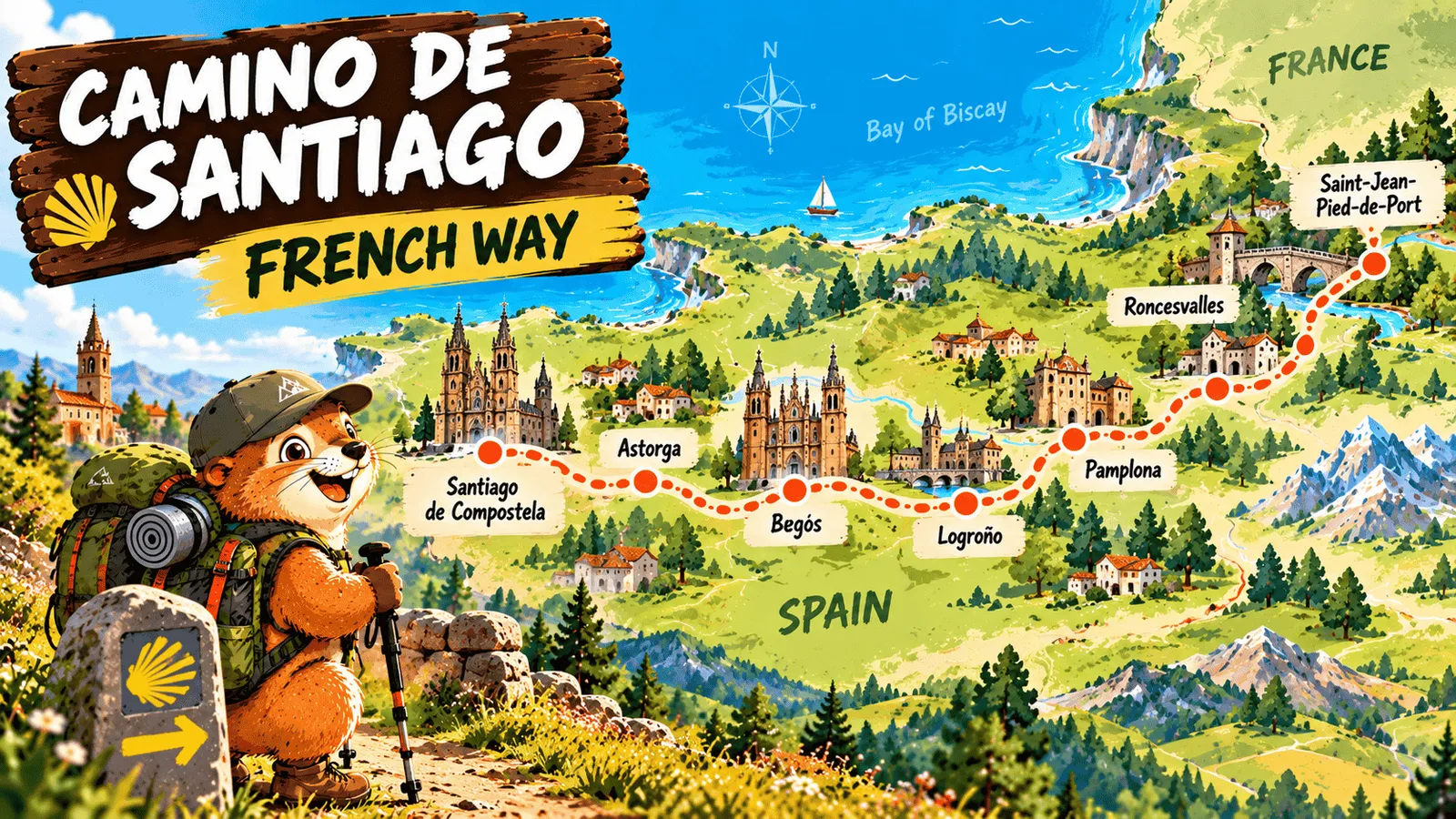
The Camino de Santiago’s French Way (Camino Francés) is the best-known route of the historic pilgrimage network, running from Saint-Jean-Pied-de-Port over the Pyrenees and across northern Spain to the cathedral city of Santiago de Compostela.
Route overview
The trail begins with a strenuous climb over the Pyrenees on day one, then settles into a long, mostly gentle traverse across Navarre, La Rioja, and the flat Meseta plateau, before rising again through Galicia to the finish. Most walkers cover the roughly 780km in 30-35 days, resupplying and sleeping in a new town almost every night thanks to the route’s dense pilgrim infrastructure.
Difficulty
Rated moderate: the terrain is far gentler than a high-mountain trail and the route is extremely well-marked and supported, but the sheer distance and the need to walk consecutive long days for over a month make sustained fitness and good foot care essential.
Trail Map
Real, verified waypoints along the Camino de Santiago – French Way — the trailhead and key trail towns, refuges or high points. These are locator pins for orientation, not a surveyed route line; we don't plot the exact path since we don't have accurate GPS data for it.
Good for
- Hikers wanting a long-distance trail with strong infrastructure and a built-in community
- Anyone drawn to the cultural and historical pilgrimage tradition
- Hikers who prefer gentler, well-marked terrain over high-mountain trails
Think twice if
- You're looking for solitude — it's one of the busiest long-distance trails in the world
- You're not prepared for very hot, exposed stretches across the Meseta in summer
- You dislike walking sections of road or tarmac between villages
Accommodation
A dense network of pilgrim albergues (hostels) the entire way, plus hotels and guesthouses in larger towns.
Getting there
Fly into Biarritz (France) or Pamplona (Spain), then bus or train to Saint-Jean-Pied-de-Port. From the finish in Santiago de Compostela, Santiago–Rosalía de Castro Airport has onward connections.
Estimated trip costs
Rough relative cost per category, not a quote — actual prices vary by season, nationality and how you travel.
Accommodation
€
Food
€
Transport
€
Permits
€
Trail Tips
Book albergues ahead in peak season (July–August), when the route gets genuinely crowded.
A lightweight sleeping bag liner is standard kit for albergue stays.
Break in your boots well before starting — blisters are the most common reason pilgrims quit early.
🦫Marmot's Trail Tip
⚠️Before you go
FAQ
Do I need to book accommodation in advance on the Camino Francés?
It's not strictly required for most of the year, since albergues are spaced closely together, but during peak summer months booking ahead — or starting early each day — avoids arriving to a full hostel.
How fit do I need to be for the French Way?
The terrain itself is gentle compared to alpine trails, but walking 20-30km a day for over a month is a real physical commitment — most pilgrims build up distance gradually in the first week.