
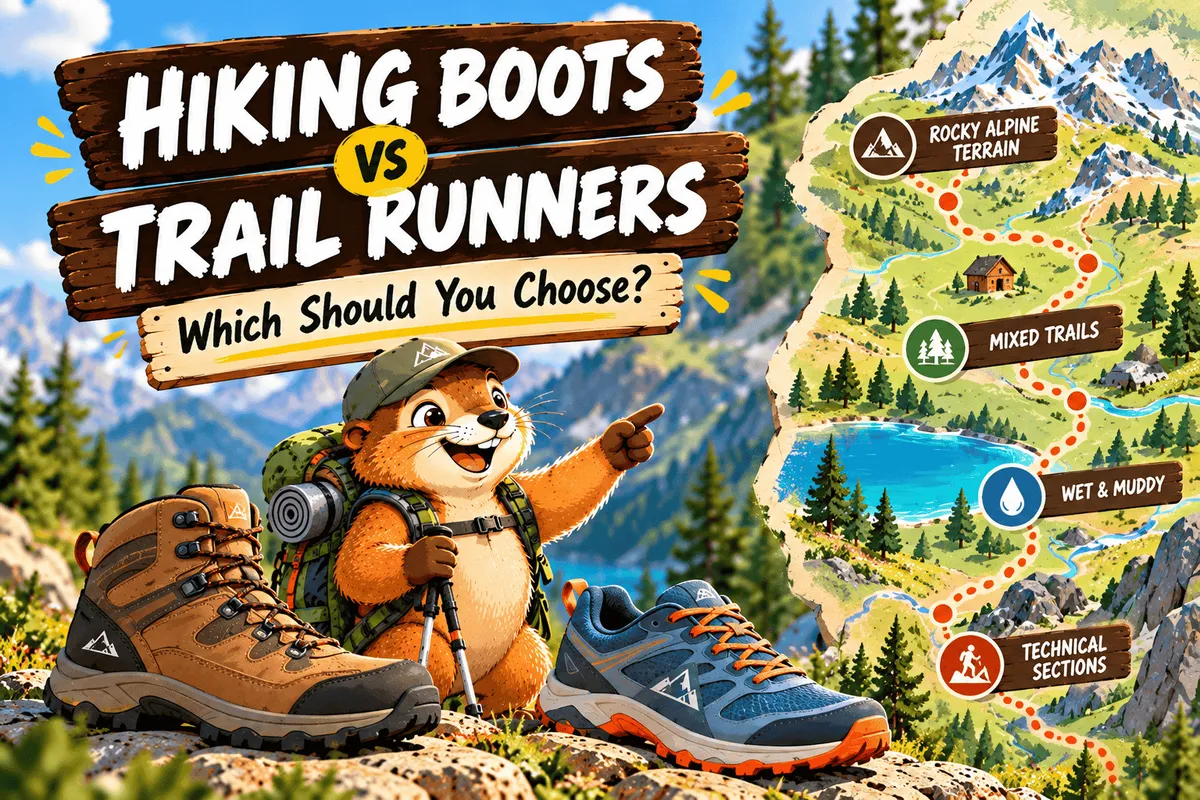
Hiking Boots vs Trail Runners: Which Should You Choose?
Published 25 September 2026 · Updated 28 September 2026


Summary
Trail runners are generally lighter and dry faster, while hiking boots offer more structure, protection and weather resistance. The right choice depends on terrain, pack weight, weather and personal preference.
Hiking boots or trail runners is one of the most debated gear questions in hiking, and the honest answer is that it depends more on the trail and the hiker than on one shoe being universally better.
⚡Quick answer
Trail runners are generally lighter and dry faster, while hiking boots can provide more structure, protection and weather resistance. The right choice depends on terrain, pack weight, weather and personal preference.
Trail runners | Hiking boots | |
|---|---|---|
| Weight | 🟢 Light | 🔴 Heavy |
| Drying speed | 🟢 Fast | 🔴 Slow |
| Breathability | 🟢 Usually better | 🟡 Varies |
| Protection | 🟡 Moderate | 🟢 Higher |
| Ankle coverage | 🔴 Low | 🟢 High |
| Long-distance comfort | 🟢 Excellent for many hikers | 🟢 Good |
| Wet conditions | 🟡 Depends on the model | 🟢 Often better |
| Rocky terrain | 🟡 Model dependent | 🟢 Often better |
Weight matters more than you think
Trail runners are lighter, typically by 200-300g per shoe compared to a mid-cut boot. That difference matters more than it sounds: footwear is “moving weight” you lift with every step, and the old backpacking rule of thumb is that a pound on your feet costs roughly the same energy as several pounds in your pack. If you’re already working on cutting pack weight, footwear is one of the highest-leverage places to look next — see our guide to packing lighter.
🎒 Want to see where your pack weight goes?
Try the TrailKit Pack Weight Calculator — break your gear list down by category and see a live weight breakdown chart.
Trail runners
- Weight — the lightest footwear option, usually 600-750g for a pair.
- Flexibility — a flexible sole moves naturally with your foot, which many hikers find less fatiguing over long days.
- Breathability — mesh uppers breathe well in warm weather, at the cost of letting water in just as easily.
- Drying — because they’re built to get wet, trail runners drain and dry far faster than boots, which matters on trips with repeated stream crossings.
- Grip — modern trail runners use aggressive lugged outsoles similar to hiking boots; on dry, well-maintained trails the grip difference is minimal.
- Durability — mesh uppers wear out faster than leather or synthetic boot uppers, so expect to replace trail runners more often.
- Best terrain — maintained trails, long-distance routes, and warm-weather hiking.
Hiking boots
- Protection — a stiffer sole and toe cap protect your foot from sharp rocks and roots underfoot.
- Stability — a mid-cut or high-cut collar restricts ankle roll on uneven ground, which matters most when carrying a heavy pack.
- Weather resistance — a waterproof membrane keeps feet dry through wet grass, light rain and shallow crossings, useful in changeable climates.
- Durability — leather and synthetic boot uppers generally outlast trail runner mesh over repeated hard use.
- Rocky terrain — a stiffer sole resists twisting on loose scree and steep, technical descents.
- Heavy packs — the added structure and ankle support earns its keep once you’re carrying multi-day loads.
The trade-off: boots typically need a proper break-in period before a long trip — skipping it is one of the most common causes of blisters and hot spots.
What about hiking shoes?
Trail runners and hiking boots aren’t the only two options — hiking shoes sit in the middle:
Hiking shoes are low-cut like trail runners but built with a sturdier sole and upper closer to a boot — more structure and durability than a trail runner, without the weight or ankle coverage of a full boot. They’re a reasonable middle ground if you want more protection than a trail runner but don’t want the break-in period or weight of a boot.
What should you wear on famous European trails?
Rather than one universally “right” footwear type, it’s worth thinking about the terrain and conditions of the specific trail you’re planning:
Trail | Footwear considerations |
|---|---|
Alta Via 1 | Rocky alpine terrain — favors a stiffer sole |
Tour du Mont Blanc | Mixed terrain and changeable weather |
GR20 | Technical, rocky sections — protection matters |
West Highland Way | Wet and muddy conditions for much of the year |
Laugavegur | Variable terrain and weather, plus river crossings |
No single footwear type is universally correct for any of these — an experienced hiker in good trail runners can complete all of them. Match your choice to the conditions above and your own comfort with ankle support and wet feet, not a blanket rule.
Decision guide
- Long-distance and want to move light? → Trail runners.
- Wet, rugged terrain where you want more protection? → Hiking boots.
- Want something in between? → Hiking shoes.
Product recommendations
The comparison table at the top of this page already lines up a trail runner (GearKit TrailRunner 2) against a mid-cut boot (AeroLine Summit Mid). We’ll be adding dedicated in-depth reviews and more picks — including budget and fully waterproof options — as TrailKit’s hiking-shoes lineup grows.
TrailKit verdict
- Choose trail runners if you’re hiking maintained trails or long-distance routes, prioritize weight and all-day comfort, and don’t have a history of ankle problems.
- Choose hiking boots if you’re carrying a heavy pack, tackling rocky or technical Alpine terrain, or hike regularly in wet or muddy conditions.
- Choose hiking shoes if you want more durability and structure than a trail runner without the weight, break-in period, or full ankle coverage of a boot.
Some links on this page are affiliate links — see our Affiliate Disclosure for details.